

Working With an App Team in India From Australia
What an Australian founder can expect, week by week, from an app team based in Indore, and what to watch for with any offshore team.

Indore, 1 November 2026, our Australian clients so far have been in Sydney and Melbourne, and every client we have had came to us through a referral. The second part matters more than it sounds. Nobody found us through an ad and took a leap of faith. Someone they trusted had already worked with me and vouched for us. Our first client, a medical centre in Melbourne, had been a client of the agency where I was a senior developer and left to work with me directly.
Referrals are also a clue to why Australian founders get nervous about offshore app development. They have heard the stories. A team that goes quiet for two weeks. A build that looks nothing like the designs. A coordinator who answers every question with "we will check with the developer". Those things happen. Below is how working with us goes in practice, and what I would check with any offshore team if I were on your side of the table.
The time difference is smaller than people expect
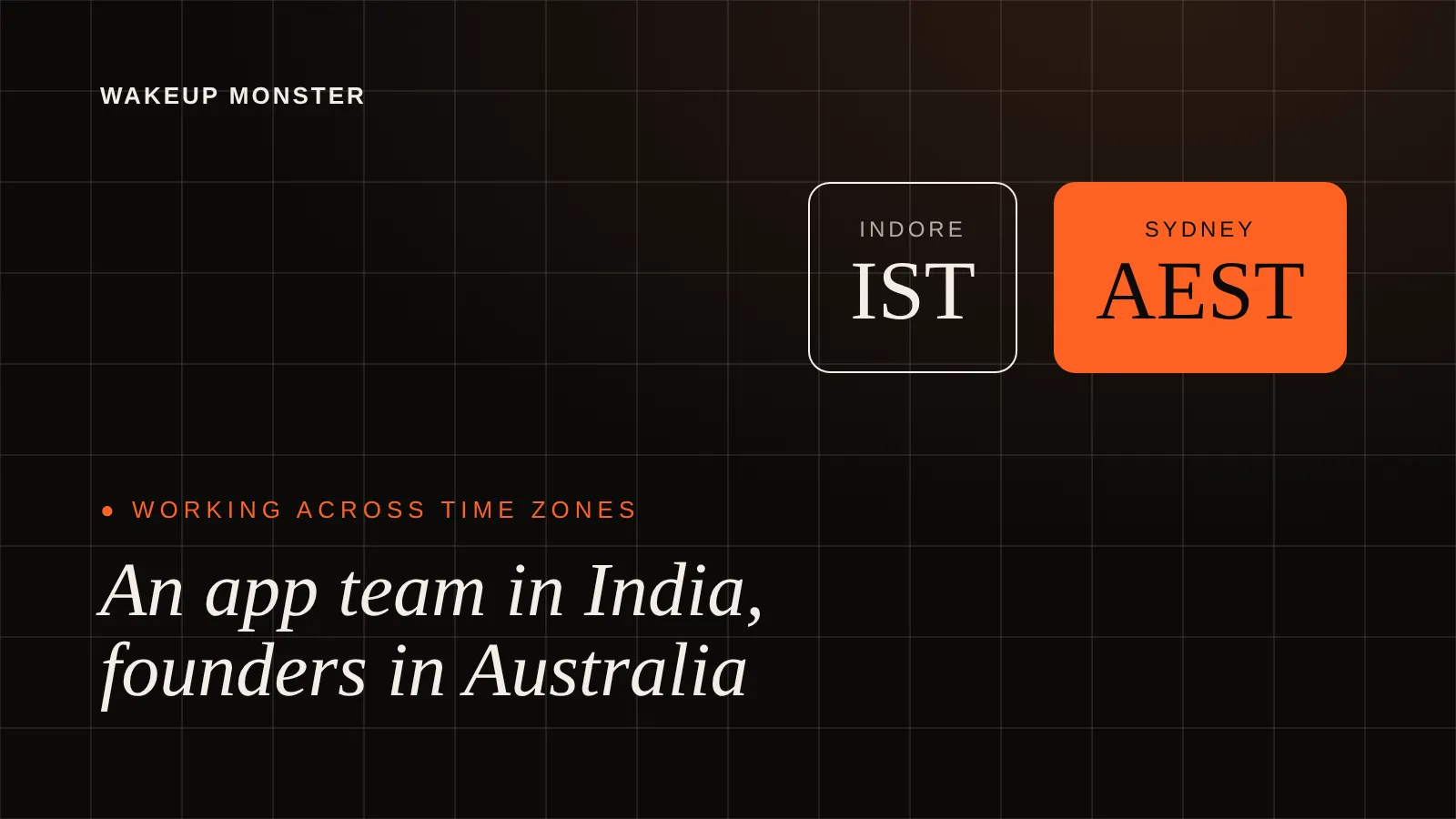
India runs on one time zone, IST, and does not change its clocks. Sydney and Melbourne do. That gives two settings for the year:
- On AEST (roughly April to October), India is 4.5 hours behind Sydney and Melbourne. 2pm in Sydney is 9:30am in Indore.
- During Australian daylight saving (roughly October to April), the gap is 5.5 hours. 3pm in Melbourne is 9:30am in Indore.
In practice your afternoon is our morning. If you want a call, early to mid afternoon in Australia lands comfortably inside our working day. If you send a message before you finish for the day, it is usually being worked on while you are asleep, and there is often something to look at when you wake up.
I will be honest about the trade-off. A team in the same city can get in a room at 9am on a Monday. We can't. Calls need a bit of planning, and a question you send at 9am Sydney time will usually wait until our morning. A fixed weekly call slot takes care of most of it. Not all of it.
Who you actually talk to
You talk to me. I am the single point of contact on every project, and I make the architecture decisions. Clients get my WhatsApp number, and that is where most quick questions get answered. There is no account manager passing messages along, and no sales person who disappears once the contract is signed.
This is partly a choice and partly the size of the studio. We are a remote-first team of 10+ people, with a lead designer, full-stack developers and the people who handle content and video. When a client asks why a screen works a certain way, or whether a feature will push the timeline, the person answering is the one who decided how it gets built. I also review and sign off every deliverable before it goes to the client.
The downside of this setup is that I am the bottleneck if I am not careful. I would rather be the bottleneck than have a client get three different answers from three different people.
How a project runs, week to week
Our full process is written up on the app development process page, so here is the short version from the client's side.
It starts with a free discovery call with me. If I don't think we are the right fit, I say so on that call. If we are, you get a proposal within 3 to 5 days covering scope, timeline, milestones and a user story document. Founders often skim the user stories. I would read them twice. They become the shared description of what the app does, and they are what both sides point to when a feature is in doubt.
Then design. Our lead designer works through every screen in Figma, and we iterate until you sign off. No code gets written until the designs are approved. In my opinion this is the best protection against the "it doesn't look like what I imagined" problem. Moving a button in Figma takes minutes. Moving it in a finished app can take days.
Once development starts, you get a progress update every week. More useful than the update is the build itself. We send test builds through TestFlight for iPhone and Google Play internal testing for Android, so you are tapping through the real app on your own phone throughout the project, not watching a demo at the end. On Keen as Mustard, a dating app for Josie and Ryan in Sydney, we ran those builds past 546 internal testers before the hand-off.
There is one thing we ask in return. We expect clients to respond within 24 to 48 hours. When a design question or a test build sits unanswered for a week, the team either waits or guesses. Both are bad for the timeline. It is the most common reason projects drift, and it is not unique to offshore work.
What can go wrong with offshore teams, and how to check
None of this is specific to India. It is what goes wrong when a client and a team are far apart and the client can't see the work. These are the patterns I would look for:
- Nobody senior on your calls. If every conversation is with a coordinator who has to "check with the team", ask to speak to whoever will make the technical decisions, before you sign.
- Nothing to install until the end. Ask how and when you will get test builds. If the answer is a demo video or a link at the finish line, you will find problems late, when they are expensive to fix.
- Vague scope. A proposal without user stories or milestones leaves room for both sides to remember the agreement differently. Ask for the written scope before you commit.
- Accounts in the agency's name. Your App Store and Play Store developer accounts, your cloud hosting and your domain should belong to you, with the team invited in. Ask who will own each one.
- No real references. Ask to talk to a past client rather than only reading a testimonial. A team that has done good work can usually arrange it.
- Silence. Pay attention to how fast they reply before you sign. It rarely gets faster afterwards.
Our guide on how to choose an app development agency goes further into the questions to ask and the answers that should worry you.
Why some Australian founders choose a team in India
The main reason I hear is that a small studio in India can put a full product team on a startup app: design, Flutter development for iOS and Android, the backend, the admin panel, testing and store launch support, all under one roof. For a first-time founder, having one team own all of that is easier than coordinating a designer, a freelance developer and a separate backend contractor.
The other reason is the working pattern itself. Because our day runs while Australia sleeps, a well-run project can feel like it moves overnight. You send feedback in the afternoon and wake up to the change. That only works if communication is tight, which is why the weekly updates and the 24 to 48 hour response window matter so much.
It is not the right choice for everyone. If you want people physically in your office, or you need someone on site, a local team is the better fit, and I will tell you that on the discovery call.
Before you get in touch
If you are weighing this up, it helps to have a rough idea of what the app needs to do and who it is for. You don't need a spec. Our FAQ covers the usual first questions, like how soon you get a proposal and whether we can take over an app another team started.
When you are ready, book a discovery call through the contact page. It is free, it is with me, and if we are not the right team for your project you will hear that from me directly.
Questions we get about this
What is the time difference between India and Sydney or Melbourne?
India is 4.5 hours behind Sydney and Melbourne when they are on AEST, and 5.5 hours behind during Australian daylight saving. India does not change its clocks. The Australian afternoon overlaps with Indian working hours, so calls are easiest in your early to mid afternoon.
Who will I be talking to during the project?
Rajat Khoware, our founder, is the single point of contact on every project and makes the architecture decisions. He also reviews and signs off every deliverable before it reaches you. Clients get his WhatsApp number for quick questions, plus a written progress update every week, so there is no account manager relaying messages in between.
How will I see progress if the team is offshore?
You get weekly progress updates and test builds through TestFlight for iPhone and Google Play internal testing for Android, so you can use the real app on your own phone throughout development. Designs are signed off in Figma before any code is written.
What do you need from me as a client?
Mainly quick replies. We expect clients to respond within 24 to 48 hours to design questions and test builds, so the team never has to wait or guess. Before the first call, a rough idea of what the app does and who it is for is enough.