
How Long Does It Take to Build an App? Our Real Timelines
Three recent builds, three different timelines, and what actually decided how long each one took.

Indore, 12 November 2026, "How long will it take?" is usually the second question on a discovery call, right after "can you build this?". The honest answer is that it depends on scope, and founders hate that answer. So instead of a range pulled from thin air, here is what our last three projects actually took, and why.
The short answer
Most of our app projects take between three and six months from signed proposal to handover. A focused website can be done in under three. Anything that sounds faster usually skips design sign-off or testing, and those are the two things I would never cut.
Three real projects, three timelines
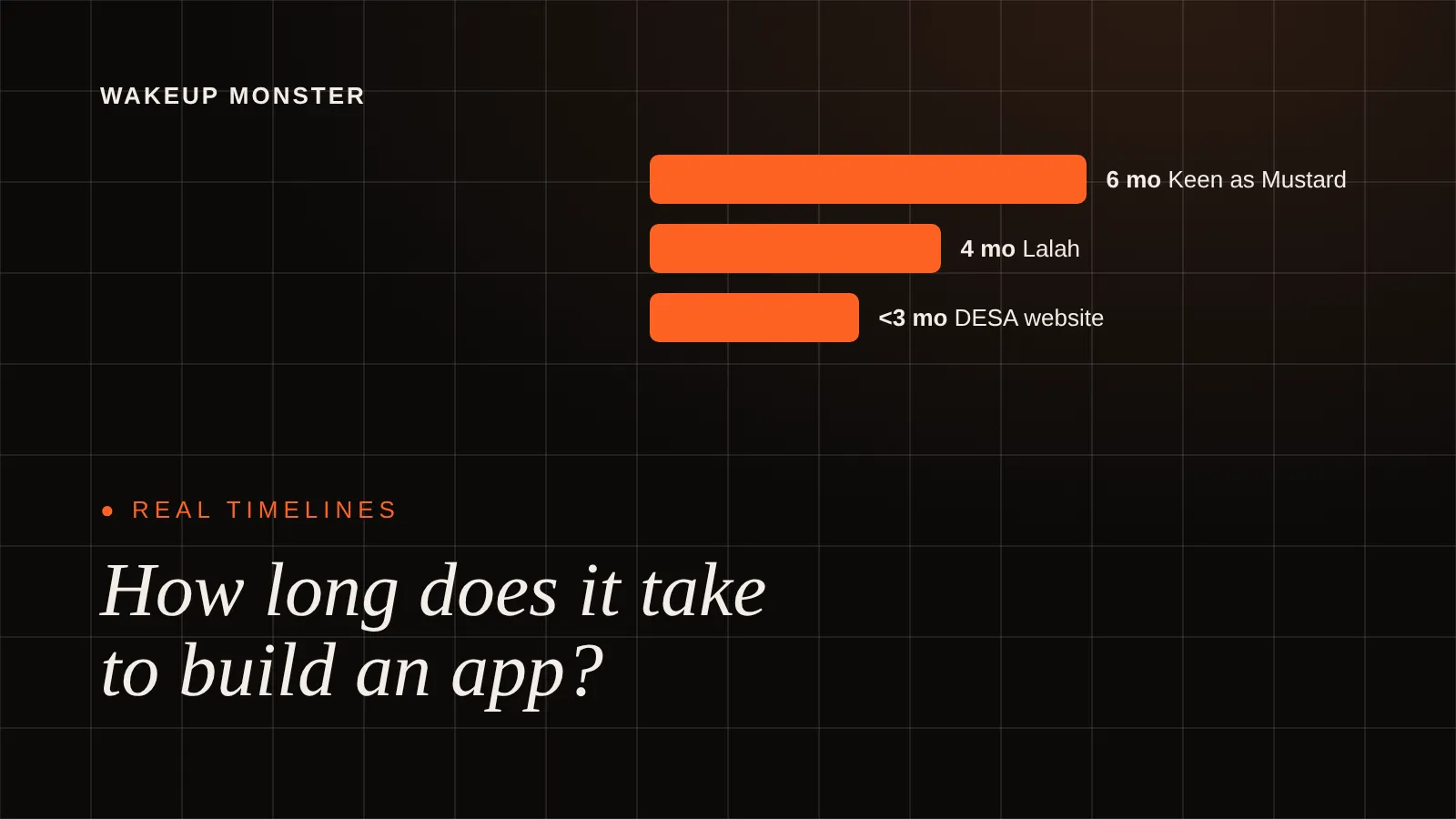
- Keen as Mustard: a Flutter dating app with 100+ screens, a Node.js backend with 50+ API endpoints, a React landing page and an admin panel. Six people, six months, delivered on time.
- Lalah: a halal food discovery app of around 40 screens, plus a landing page, an admin panel and a backend. Five people, four months of active development.
- DESA Consulting: a 12-page WordPress website for a Melbourne medical centre, with HotDoc online booking. Four people, under three months.
Look at what separates them. It is not the technology. Keen and Lalah both use Flutter and Node.js. The difference is how many screens, how many products around the app, and how much needs testing before anyone outside the team sees it.
What actually decides the timeline
Number of screens
Every screen has to be designed, reviewed, built and tested on two platforms. Going from 40 screens to 100+ did not add a few weeks to Keen as Mustard. It added months, because each feature brought its own empty states, error states and edge cases.
How many products sit around the app
An app rarely ships alone. Both of our app projects also needed a landing page, an admin panel and a backend. The admin panel is the one founders forget. On Keen it handles verification, giveaways, subscriptions and moderation, and none of that builds itself.
How fast decisions come back
This one is on both sides. We ask clients to reply to questions within 24 to 48 hours. A design review that sits unanswered for a week moves the launch by a week.
Surprises halfway through
Keen as Mustard had to be renamed about four months in, when the original name could not be trademarked. New name, logo, palette and identity, in the middle of the build. The project still finished on time, and the rebrand went through without a change order.
Where the time goes
Here is roughly how a project moves, using our own app development process:
- A free discovery call with me.
- A written proposal with scope, timeline, milestones and user stories within 3 to 5 days.
- Design in Figma until you sign off every screen. No code before that.
- Development sprints with weekly updates and test builds you install on your own phone through TestFlight or Google Play internal testing.
- Structured QA. Keen as Mustard went through 546 internal testers before handover.
- Store submission, handover documentation and post-launch support.
Design and testing are the stages people want to shorten. They are also the ones that stop a project from running late. Fixing a layout in Figma takes minutes. Fixing it after it has been built twice, once for iOS and once for Android, takes days.
How to get a faster first version
If you need something in front of users sooner, cut scope, not quality. Pick the one journey that proves your idea, build that properly, and leave the rest for version two. Our startup MVP page covers how we decide what makes the first release.
A good first question to ask any agency, including us, is: which of your past projects is closest to mine, and how long did it take? If they can't name one, treat their estimate with care.
If you want a realistic timeline for your own idea, book a discovery call. You will speak to me directly, and if we are not the right fit I will tell you.
Questions we get about this
How long does it take to build a mobile app?
At WakeUp Monster, most app projects take three to six months from signed proposal to handover. Our 40-screen Lalah app took four months of development and our 100+ screen Keen as Mustard app took six months. Smaller scopes can be faster, and adding an admin panel or complex features adds time.
How long does a business website take?
A focused website is usually faster than an app. Our 12-page healthcare website for DESA Consulting in Melbourne, including HotDoc online booking, was delivered in under three months by a four-person team. Content revisions and approvals are often what decide the final date.
How quickly do I get a proposal?
After a free discovery call with the founder, Rajat Khoware, you receive a written proposal within 3 to 5 days. It covers scope, timeline, milestones and the user stories for your product, so you know what will be built and in what order before any work starts.
What makes an app project run late?
The most common causes are scope that keeps growing, slow decisions on designs and questions, and skipping proper design sign-off before development. We ask clients to reply within 24 to 48 hours and get every screen approved in Figma before code, which keeps a project on schedule.